- Ak india
Responsive Ads Here

Post Top Ad

Your Ad Spot

Tuesday, 28 August 2018

DEFENSE

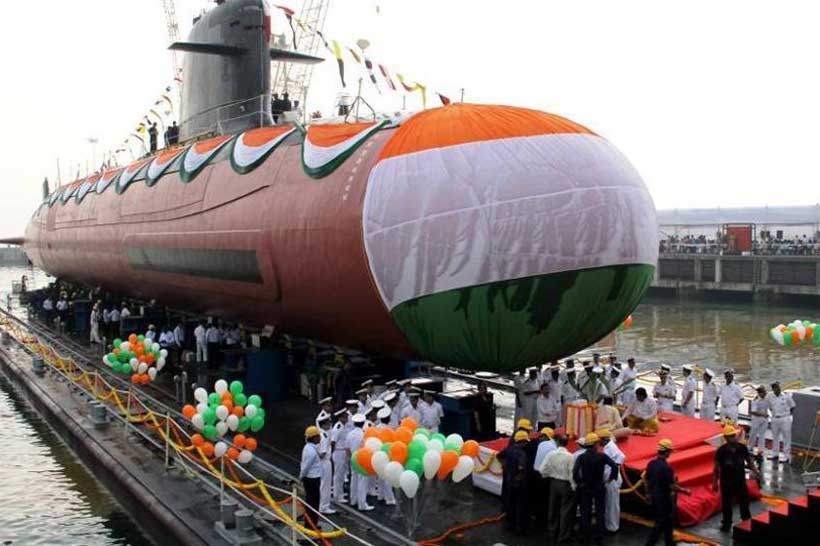
INS Arihant Accidents: Question Mark on the Sustainability of India’s Naval Force

The Indian navy inducted first indigenously built nuclear-armed submarine, the INS Arihant in 2009.  It was jointly developed by the Indian Navy, Bhabha Atomic Research Centre (BARC) and Defence Research and Development Organization (DRDO) at the naval shipyard in Visakhapatnam. Russian engineers assisted in building the vessel.
India has leased 16 diesel-electric submarines from Germany and Russia. However, the weakness with diesel electric submarines is that they cannot stay under water for a long time. Conventional diesel-electric submarines have to ascend to the surface each day to discharge carbon dioxide produced by the generator. Nuclear-powered submarines can stay under water for long durations without being detected. Many observers claim thatit is first operational Ship Submersible Ballistic Nuclear (SSBN) asset of India which can stay hidden deep underwater for a long period. According to them it would also play an increasing role in the country’s nuclear deterrence because it is capable of launching ballistic missile carrying nuclear warheads from the depth of the ocean.It has four sea-launched ballistic missile (SLBM) tubes. Its four tubes have the capability to operate a short range SLBM (K-15 Sagarika) estimated at 750 km and future versions of the class will be capable of firing long range (estimated at 3,500 km) K-4s.Arihantis operated by 100 men with extensive training from the School for Advanced Underwater Warfare in Visakhapatnam. India now joins a small group of states that are capable of indigenously building nuclear submarines. Indian former Prime Minister Manmohan Singh, professed that the indigenously built submarine would be used for self defence. The name Arihant originates from two words “Ari’ meaning enemy and “Hant” meaning destroy.
Some observers also claim that the emergence of the INS Arihant raises India’s status as a rising naval power because its deployment in the Indian Ocean will strengthen Indian naval force projection. The reality is that Arihant has faced many accidents, and if it could not save itself from those mishaps how could it possibly raise the status of India? INS Arihant, has suffered major damage and has been out of commission for more than nine months in 2018.The cause of the damage is the water that rushed in because a hatch on the left side remained open by mistake. India has never established a nuclear submarine before, has never operated an SSBN, and holds very limited experience.Not only now it possesses a damaged Arihant, but it also puts a question mark on the Indian$2.9 billion project and naval force.
The Arihantcase is not astonishing because Indian navy doesn’t show a good record in recent years in handling its conventional and nuclear-powered submarine forces. Before, the damage of Arihant India faced an accident of INS Chakra which was leased from Russia.In 2013 INS Sindhurakshak after the Kilo-class submarine agonized a major detonation during berthing in Mumbai. This incident was caused by human error and has taken the lives of eighteen sailors. In 2014, INS Sindhuratna, an Indian Kilo-class submarine, experienced a fire incident on board and two crewmen died in this incident due to asphyxiation.That incident didnot occur due to the human error, but because of the poor maintenance of the vessel.
Most scholars claimed that the SSBN force may have serious effects on Pakistan and China with endangering arms race in the region. Simply it is not reality, because India’s navy could not improve submarine operations and maintenance and it is facing technical difficulties. The first technical challenge is the successful integration of ballistic missiles with the nuclear submarine.  India could not make considerable progress in developing underwater deterrence.It needs more efforts to overcome all these technical problems to launch a robust triad. It is not difficult to predict that a fully operational nuclear submarine would take 10 to 20 years. The first few submarines, including, INS Arihant is as a technology demonstrator rather than a vigorous deterrent projector. Arihant has faced many problems from the start and still experiencing repairs for damage. The performance of these vessels belongs to the first and second generation of SSBNs. For the sea based deterrence India needs S-5 vessel and a powerful reactor,which will take two decades more.

Research Associate at Strategic Vision Institute Islamabad

DEFENSE

Call for Naval Nuclear CBM’s between South Asian Nuclear Rivals

Published
  
on
 
In complex and dynamic South Asian security structure, new security concerns are evolving without the previous ones being resolved, leading to further deterioration of regional security. Security dynamics of region are dominated by the power play between nuclear arch rivals of the region – India and Pakistan. Even before their nuclearization, both states went for an all-out war with each other and their animosity and mistrust eventually led to the nuclearization of the region.  Since their overt nuclearization in 1998 both states have not ventured into an all-out war but that does not mean that all is well between both nuclear rivals.
According to recent trend of arms buildup and weaponization in the region one can easily predict that although fear of mutual vulnerability has stopped both sides to attack each other but it is failing in halting the arms race in the region. However, appalling aspect in this arms race is that it has no bounds and it is spreading into ocean, space and cyber space as well, which is causing destruction of natural and virtual habitat. Recently, both states are all rage about naval nuclearization to achieve credible second strike capability or to acquire deterrence at all levels of conflict. After witnessing India’s rapid naval build-up which includes air-craft carrier, conventional submarines, naval fleets, ballistic and cruise missiles like (K4-K15, Sagarika, Brahmos and Dhanush), indigenously built fleets of SSBNs and SSNs, Pakistan also went ahead with achieving the second strike capability in order to extend deterrence at all levels of conflicts.
Making its borders secure is the inalienable right of every state and so is the protection of its interests. But, it is also the obligation on every state to reduce the chances of accidental conflicts, crisis or war, if there are any, for the peace, stability and welfare of the people. One thing that the Cold War should have taught the belligerent South Asia neighbors is that there is no end to arms race; once deterrence is acquired it should not be tested with new doctrinal thoughts or new technological innovations. States’ policies, doctrines and technological innovations compel them to pie-up fancy weaponry by resorting to continuous arms build-up. This surely has repercussions. Similarly, weaponization int he sea while difficult is quite dangerous. It is managed through different mechanisms and requires a lot of time. Talking particularly about the Indian Ocean, it probably shouldn’t have been nuclearized and militarized in the first place. The seas remain to be the main source proving line of communication. However, since the Indian Ocean is now already nuclearized, the need is for both India and Pakistan to work out the measures which would help avoid accidental conflicts as both parties are new to this arena and are eagerly flexing their muscles.
Thus, to avoid nuclear clash and accidental nuclear conflicts it is necessary that both states revive dialogue process as offensive attitudes will not help the either side in achieving their interests. Level of alertness, command, control systems and vessels with dual capabilities has further complicated the sea based operations and add an element of ambiguity to it.  Both India and Pakistan are newbies in naval nuclear technology, thus, chances of accidents are highly likely. So, it is pertinent that both states develop and keep the communication channels open through which any probable naval nuclear accident should be communicated to the other side. Establishment of Hotline between naval officers of both states could be one of the significant means of communication to avoid any confusion and ambiguity in the event of accident or crisis.
Both India and Pakistan are developing new missile technologies, especially cruise missiles and are tipping them with nuclear weapons to be used in naval ships and in naval submarines. Both states already have CBMs about pre-notification of ballistic missile tests, but it does not entail the cruise missiles. So considering latest developments it is necessary that both states sign certain CBMs regarding missile tests.
Although general perception is that CBMs in South Asia have not achieved much but in complex nuclear environment where animosity is at peak faith in these small initiatives to reflect goodwill can perform miracles and resultantly can reduce the distrust, animosity, tension and conflict.
CONTINUE READING

DEFENSE

Pakistan’s Nuclear Safety and Security

Sonia Naz
Published
  
on
 
By
  
Wyn Bowen and Matthew Cottee discuss in their research entitled “Nuclear Security Briefing Book” that nuclear terrorism involves the acquisition and detonation of an intact nuclear weapon from a state arsenal. The world has not experienced any act of nuclear terrorism but terrorists expressed their desires to gain nuclear weapons. The International Atomic Energy Agency (IAEA) has observed many incidents of lost, theft and unauthorized control of nuclear material. The increased use of nuclear technology for peaceful purposes has intensified the threat that terrorist can target these places for acquiring nuclear materials. They cannot build a nuclear weapon because production of a nuclear weapon would require a technological infrastructure. Thus, it is the most difficult task that is nearly impossible because the required infrastructure and technological skills are very high which even a strong terrorist group could not bear easily, but they can build a dirty bomb.
A dirty bomb is not like a nuclear bomb. A nuclear bomb spreads radiation over hundreds of square miles while nuclear bomb could cause destruction only over a few square miles. A dirty bomb would not kill any more people than an ordinary bomb but it would create psychological terror. There is no viable security system for the prevention of nuclear terrorism, but the only possible solution is that there should be a stringent nuclear security system which can halt terrorists from obtaining nuclear materials.
The UN Security Council and the IAEA introduced multilateral nuclear security initiatives. Pakistan actively contributed in all international nuclear security efforts to prevent nuclear terrorism. For example, United States President Barak Obama introduced the process of Nuclear Security Summit (NSS)in 2009 to mitigate the threat of nuclear terrorism. The objective of NSS was to secure the material throughout the world in four years.
Pakistan welcomed it and not only made commitments in NSS but also fulfilled it. Pakistan also established a Centre of Excellence (COEs) on nuclear security and hosted workshops on nuclear security. In addition to all this, Pakistan is a signatory of UN Security Council Resolution (UNSCR) 1540 and affirms its strong support to the resolution. It has submitted regular reports to 1540 Committee which explain various measures taken by Pakistan on radiological security and control of sensitive materials and Weapons of Mass Destruction (WMD) transfer. Pakistan is the first country which submitted a report to the UN establishing the fact that it is fulfilling its responsibilities. Pakistan ratified Convention on the Physical Protection of Nuclear Material (CPPNM) in 2016. It is also the member of Global Initiative to Combat Nuclear Terrorism (GICNT). It can be rightly inferred that Pakistan is not only contributing in all the international nuclear security instruments but has also taken multiple effective measures at the national level.
Pakistan created National Command Authority (NCA) to manage and safeguard nuclear assets and related infrastructures. The Strategic Plan Division (SPD) is playing a very important role in managing Pakistan’s nuclear assets by collaborating with all strategic organizations. Establishment of Pakistan Nuclear Regulatory Authority (PNRA)in 2001 is another development in this regard. The PNRA works under the IAEA advisory group on nuclear security and it is constantly improving and re-evaluating nuclear security architecture. National Institute of Safety and Security (NISAS) was established under PNRA in 2014. Pakistan has also adopted the Export Control Act to strengthen its nuclear export control system. It deals with the rules and regulations for nuclear export and licensing. The SPD has also formulated a standard functioning procedure to regulate the conduct of strategic organizations. Christopher Clary discusses in his research “Thinking about Pakistan’s Nuclear Security in Peacetime” that Pakistan’s nuclear arsenals are equipped with Permissive Action Links (PALs) for its stringent security. According to Pakistan’s former nuclear scientist Samar Mubarakmand, every Pakistani nuclear arsenal is now fitted with a code-lock device which needs a proper code to enable the arsenal to explode.
Nonetheless the nuclear terrorism is a global concern and reality because terrorist organizations can target civilian nuclear facility in order to steal nuclear material. The best way to eradicate the root of nuclear terrorism is to have a stringent nuclear security system.
Western media and outsiders often propagate that Pakistan’s nuclear arsenals can go into the wrong hands i.e. terrorists, but they do not highlight the efforts of Pakistan in nuclear security at the national and international level. The fact is that Pakistan has contributed more in international nuclear security efforts than India and it has stringent nuclear security system in place.
CONTINUE READING

DEFENSE

India’s Probable Move toward Space Weaponization
Published
  
on
 
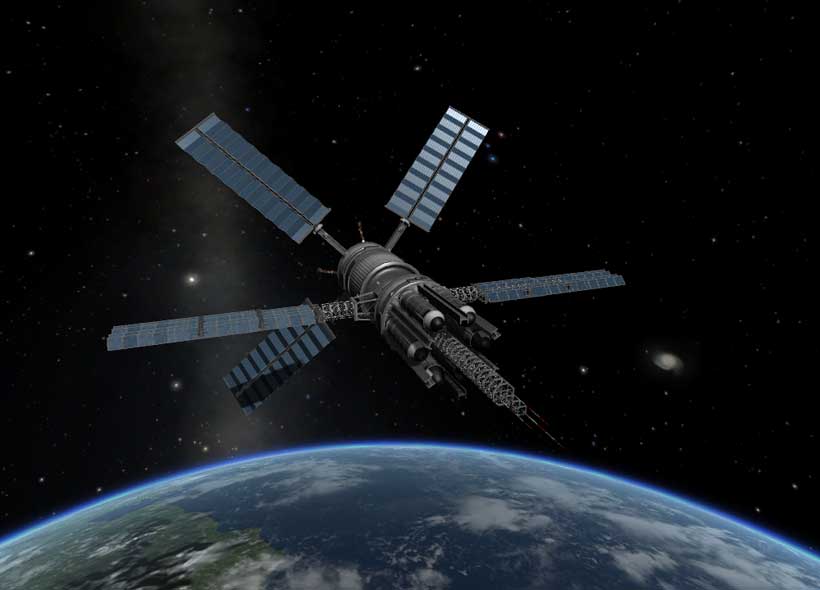
The term Space Weaponization tends to raise alarm as it implies deployment of weapons in the outer space or on heavenly bodies like Sun and Moon or sending weapon from earth to the outer space to destroy satellite capabilities of other states. Thus, space weaponization refers to the actions taken by a state to use outer space as an actual battlefield.
Space militarization on the other hand is a rather less offensive term which stands for utilization of space for intelligence gathering, surveillance and reconnaissance missions through satellites to support forces on ground in the battle field. Space militarization is already in practice by many states. In South Asia, India is utilizing its upper hand in space technology for space militarization. However, recent concern in this regard is India’s attempts to weaponize space, which offers a bleak situation for regional peace and stability. Moreover, if India went further with this ambitiousness when Pakistan is also sending its own satellites in space, security situation will only deteriorate due to existing security dilemma between both regional counterparts.
Threats of space weaponization arise from the Indian side owing to its rapid developments in Ballistic Missile Defenses (BMDs) and Inter-Continental Ballistic Missiles (ICBM). Both of these technologies, BMDs and ICBMs, hand in hand, could be used to destroy space based assets. In theory, after slight changes in algorithms, BMDs are capable of detecting, tracking and homing in on a satellite and ICBM could be used to target the satellites for intelligence, surveillance and reconnaissance.
Many international scholars agree on the point that BMD systems have not yet acquired sophistication to give hundred percent results in destroying all the incoming ballistic missile, but they sure have the capability to work as anti-satellite systems. The reason behind the BMD being an effective anti-sat system is that it is easier to locate, track and target the satellites because they are not convoyed with decoys unlike missiles which create confusions for the locating and tracking systems.
India possesses both of the above-mentioned technologies and its Defense Research and Development Organization has shown the intention to build anti-satellite weaponry. In 2012, India’s then head of DRDO categorically said that India needs an arsenal in its system that could track the movement of enemy’s satellite before destroying it, thus what India is aiming at is the credible deterrence capability.
One thing that comes in lime light after analyzing the statement is that India is in fact aiming for weaponizing the space. With the recent launch of its indigenous satellites through its own launch vehicle not only for domestic use but also for commercial use, India is becoming confident enough in its capabilities of space program. This confidence is also making India more ambitious in space program. It is true that treaties regarding outer space only stop states from putting weapons of mass destruction in outer space. But, destruction of satellites will create debris in outer space that could cause destruction for other satellites in the outer space.
On top of it all the reality cannot be ignored that both Pakistan and India cannot turn every other arena into battlefield. Rivalry between both states has already turned glaciers and ocean into war zones, resultantly affecting the natural habitat of the region. By going for ballistic missile defences and intercontinental ballistic missiles India has not only developed missile technology but also has made significant contribution in anti-sat weaponry, which is alarming, as due to security dilemma, Pakistan will now be ever more compelled to develop capabilities for the security of its satellites. So far both states are confined till space militarization to enhance the capabilities of their forces, but if that force multiplier in space goes under threat, Pakistan will resort to capability to counter Indian aggression in space as well, which will be the classic action-reaction paradigm. Thus, it is pertinent that India as front runner in space technology develop policy of restrain to control the new arms race in the region which has potential to change the skies and space as we know them.
CONTINUE READING

TRENDING

1 comment:

Next Post

RRB Group D Result 2018-19 LIVE Updates: Result delayed, check updates

RRB Railway Group D Result 2018-19 live update:"the results of Group D examinationns are likely to be available on all the websites o...

Post Top Ad

Your Ad Spot